Define the missing direction
Write down who cannot hear whom. If the customer cannot hear the office, follow audio sent by the office toward the customer. Avoid the ambiguous statement that the customer has no audio.
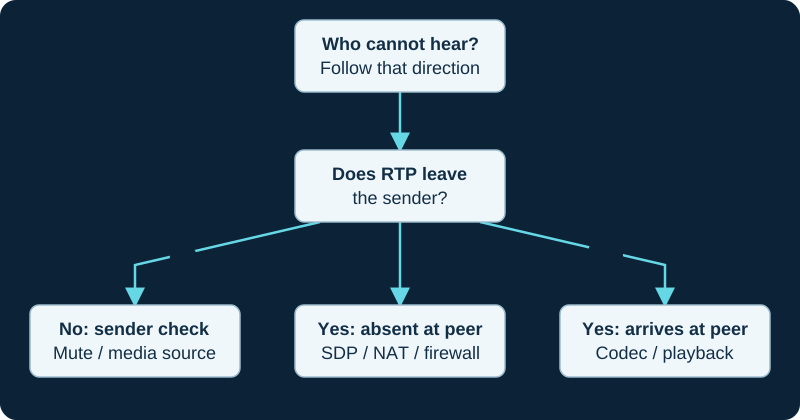
Follow one missing direction. Repeat on each PBX call leg and verify hold and transfer after a repair.
Most useful first checks
Compare an internal call, an external call and a call from another endpoint. A working internal call narrows the problem toward the path that changes at the carrier or remote-network boundary. Check mute and the selected headset before changing network settings.
Follow the media
Inspect the SDP address and port on each affected call leg, then compare actual RTP destinations. Determine whether packets leave the sender, reach the PBX and leave toward the receiver. Check NAT translation, firewall policy and whether direct media changes the expected path.
In Asterisk, inspect the loaded endpoint and topology-specific PJSIP NAT settings. In FreePBX, review the managed SIP/network settings through its supported interface. Do not paste standalone transport fragments over generated files.
Confirm the repair
Change only the setting supported by the evidence. Re-test both call directions, hold and transfer, because renegotiation can introduce a different media path. Keep the firewall enabled and remove temporary broad logging. A successful registration is not the acceptance criterion for this problem.
Watch the explanation
Compares an intact RTP capture with a copy containing deliberately removed packets. The stream list and detailed analysis show how gaps become loss indicators and how burst patterns differ from scattered loss.
Read applicability and editorial notes →Watch this video here
A 2024 Wireshark demonstration; menu placement can change. The second capture is a teaching fixture with simulated loss. Review used the available transcript and primary references; audio and screen readability remain unverified.

The player loads only when you choose Watch here. Playback uses YouTube’s privacy-enhanced embed; YouTube processes playback data.
Sources & applicability
Primary references for the technical details above. Operational examples and planning checklists are VoIP.info editorial guidance.
- IETF RFC 3261 — SIP, including linked updates ↗
- IETF RFC 3550 — RTP and RTCP ↗
- Asterisk res_pjsip configuration ↗
Examples require adaptation to your topology. No live PBX or hardware testing is claimed.