Capture where the question is observable
A normal switch port does not show all other ports' unicast traffic. Use an authorized endpoint capture, switch mirror, network TAP or supported virtual capture path. For a border problem, simultaneous inside and outside observations can reveal where addresses change or packets disappear. Confirm direction coverage and mirror-port capacity. An overloaded mirror destination can drop copies even when production packets arrive successfully. A capture gap is therefore evidence about the capture until corroborated by another point or endpoint counters.
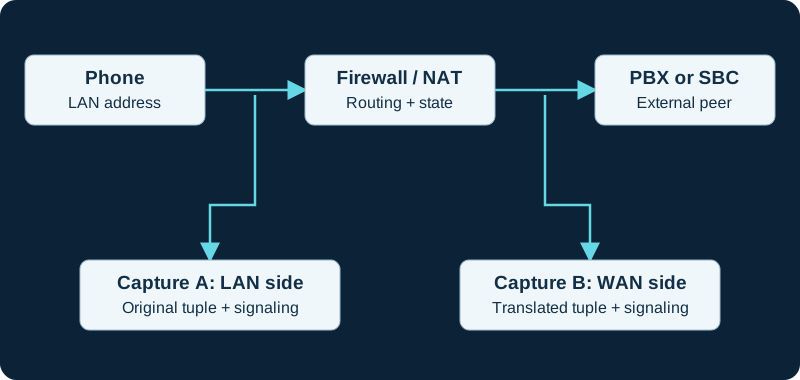
Paired observations help locate a change or loss. Account for clock offset, NAT and capture drops before attributing a difference to the network.
Set scope before starting
Record the test endpoints, expected signaling transport and negotiated media addresses. A SIP-port-only filter can omit RTP and encrypted signaling on another port. A host-only filter can miss media sent directly between endpoints instead of through the PBX. Use synchronized clocks, a bounded duration and a rotating or size-limited output. Leave enough packet data for the intended decoder; truncated packets can prevent SDP or RTP interpretation. Record capture drops and the collection interface with the file.
Compare one transaction or stream
Match packets by identifiers and content, allowing for NAT and B2BUA transformations. Host offload can produce apparent checksum or packet-size anomalies that are not wire faults. Compare a network-side capture before blaming the sender. After collection, stop the capture, secure the file and write the incident time range immediately. Keep a minimal redacted extract for collaboration. An exact description of what a vantage point cannot see is part of a useful result, especially when diagnosing one-way audio or asymmetric routing.
Watch the explanation
Explains how the problem determines where to capture, including switch mirroring and paired client/server observations. A useful first step before collecting a VoIP trace.
Read applicability and editorial notes →Watch this video here
Recorded in 2021; capture-placement principles remain useful. Exact operating-system and switch controls vary. Review used the available transcript and primary references; audio and screen readability remain unverified.

The player loads only when you choose Watch here. Playback uses YouTube’s privacy-enhanced embed; YouTube processes playback data.
Demonstrates selecting an interface, writing captures to disk and rotating a ring buffer. Helpful when a GUI capture is impractical or an intermittent fault needs a longer observation window.
Read applicability and editorial notes →Watch this video here
The capture concepts still apply; Windows and macOS path examples are from 2021. Review used the available transcript and primary references; audio and screen readability remain unverified.

The player loads only when you choose Watch here. Playback uses YouTube’s privacy-enhanced embed; YouTube processes playback data.
Sources & applicability
Primary references for the technical details above. Operational examples and planning checklists are VoIP.info editorial guidance.
Examples require adaptation to your topology. No live PBX or hardware testing is claimed.