Draw two paths
Write down where SIP requests go and where each direction of media goes. Via, Contact and Route describe signaling roles; SDP and ICE determine media possibilities. A correct public signaling address cannot by itself repair a private media address that the remote peer cannot reach. For a PBX or SBC, analyze each call leg independently. Direct-media negotiation can move RTP away from the PBX after setup, changing what a server-side capture can observe.
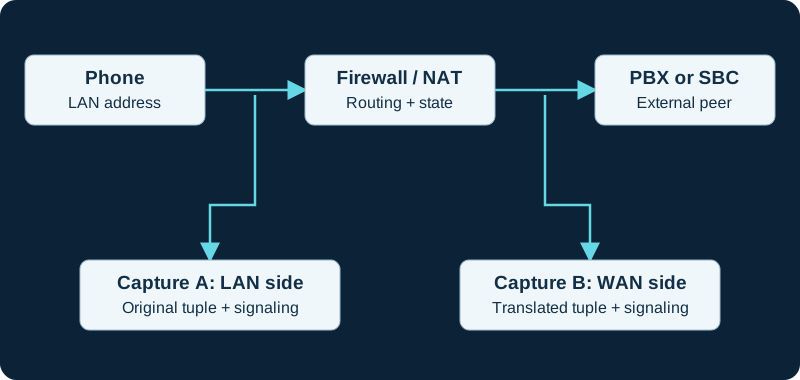
Paired observations help locate a change or loss. Account for clock offset, NAT and capture drops before attributing a difference to the network.
Compare advertised and observed addresses
Capture on both sides of the relevant boundary when authorized. Compare the advertised Contact and media addresses with actual packet source and destination tuples. Record any router ALG or intermediary rewriting; do not assume the original endpoint created every visible header value. An idle registration that stops receiving calls can involve expired state or a lost connection. A call that changes behavior after hold may involve a new SDP destination. A network failover can change the public address while an established dialog still targets the old path.
Change one owner at a time
Identify which component is responsible for NAT traversal, public address advertisement and media relay. Avoid enabling overlapping fixes blindly across router, PBX and phone. Use a pilot call and preserve the before/after evidence. Retest after an idle interval, during hold/resume and from an external network. For WebRTC, use selected ICE-pair evidence instead of only the SDP default address. Document the fixed boundary and any unsupported failover behavior; NAT recovery for new calls does not necessarily preserve existing calls.
Sources & applicability
Primary references for the technical details above. Operational examples and planning checklists are VoIP.info editorial guidance.
Examples require adaptation to your topology. No live PBX or hardware testing is claimed.