Candidates describe possible paths
ICE gathers potential transport addresses, exchanges them through signaling and tests candidate pairs. Host candidates describe local interfaces; server-reflexive candidates can describe an address learned through STUN; relayed candidates use an allocated TURN relay. A candidate's presence is a possibility, not proof that the remote peer can use it. The agents run connectivity checks and nominate a pair. Read the selected pair in diagnostics rather than guessing that media must use the address shown first in SDP.
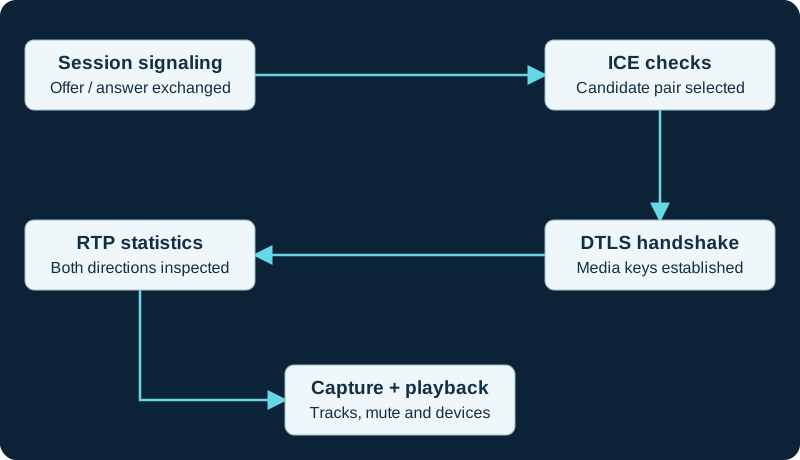
A diagnostic order, not a strict application timeline: capture can start earlier and ICE gathering may be incremental. Successful signaling alone does not prove audio works.
Gathering and checking are different stages
If no relay candidate appears, investigate TURN configuration and allocation before blaming the remote peer. If candidates appear but all checks fail, compare routing, firewall rules and whether the candidate information actually reached the other side. Trickle ICE allows candidates to be signaled incrementally. An integration that sends the initial SDP but loses later candidates can fail selectively across networks. Record whether both sides support the chosen gathering and signaling behavior.
Diagnose changes over time
A network switch can invalidate the selected path. Recovery may require an ICE restart coordinated through signaling; it is not equivalent to refreshing a SIP registration. Capture connection-state transitions and candidate-pair statistics before and after the change. Test direct and relayed operation separately. A successful office call does not demonstrate connectivity from hotel Wi-Fi or a restrictive enterprise network. For a failure report, retain candidate types, selected transport, timing and byte counters while redacting sensitive addresses. Then proceed to DTLS if ICE succeeded but protected media never starts.
Watch the explanation
Tsahi Levent-Levi and Philipp Hancke connect host, server-reflexive and relay candidates to the browser events that expose them. The narrated example distinguishes gathering from signaling.
Read applicability and editorial notes →Watch this video here
A 2025 browser API walkthrough. Candidate exposure, timings and mDNS behavior depend on browser and permissions. Review used the available transcript and primary references; audio and screen readability remain unverified.

The player loads only when you choose Watch here. Playback uses YouTube’s privacy-enhanced embed; YouTube processes playback data.
Uses the timing of candidate discovery to explain why trickling candidates can shorten connection setup. A short alternative to the longer ICE API walkthrough.
Read applicability and editorial notes →Watch this video here
Conceptual explanation from 2022; the parallel-gathering principle remains applicable. Review used the available transcript and primary references; audio and screen readability remain unverified.

The player loads only when you choose Watch here. Playback uses YouTube’s privacy-enhanced embed; YouTube processes playback data.
Sources & applicability
Primary references for the technical details above. Operational examples and planning checklists are VoIP.info editorial guidance.
Examples require adaptation to your topology. No live PBX or hardware testing is claimed.