Find the last successful boundary
Call the published number from an independent outside service. Record the timestamp and what the caller hears. Check whether the carrier delivered an INVITE to the intended PBX. No incoming request shifts attention to carrier routing, number state or the network path before the PBX.
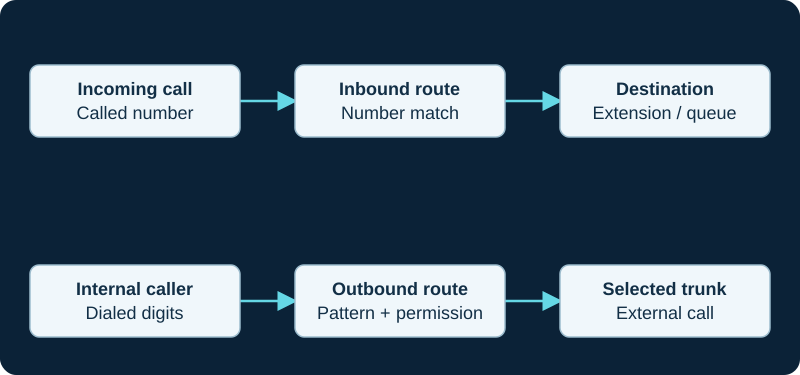
A working outbound call does not prove inbound number routing. Diagnose the direction and the matching rule independently.
If the request reaches the PBX
Confirm the incoming trunk is identified under its documented method. Then inspect the delivered DID format and matched route. A leading country code or prefix can change matching. Caller-ID filters are separate from the called number.
In FreePBX, confirm the destination exists and the latest route configuration was applied. In Asterisk, follow the incoming context and extension actually selected by the running dialplan.
Follow the destination
Check opening hours, manual overrides, ring-group membership, queue availability and voicemail fallback. A correct DID match can still lead to an unavailable extension or an after-hours destination the caller did not expect.
Retest narrowly
Test the repaired number and another existing number to detect an overly broad match. Do not leave a catch-all route in place merely because it masks an unexplained mismatch. Keep the carrier call identifier with the incident if upstream escalation is required.
Watch the explanation
Learn the difference between turning Do Not Disturb off and removing the user controls that enable it. The demonstration examines the idle mute-key action and the separate DND feature setting, which can matter when users accidentally stop their phones ringing.
Read applicability and editorial notes →Watch this video here
GRP-family web interface; the spoken model number is unclear. Match the controls to your exact model and firmware before applying a policy change. Review used the available transcript and primary references; audio and screen readability remain unverified.

The player loads only when you choose Watch here. Playback uses YouTube’s privacy-enhanced embed; YouTube processes playback data.
Sources & applicability
Primary references for the technical details above. Operational examples and planning checklists are VoIP.info editorial guidance.
- IETF RFC 3261 — SIP, including linked updates ↗
- IETF RFC 3550 — RTP and RTCP ↗
- Asterisk res_pjsip configuration ↗
Examples require adaptation to your topology. No live PBX or hardware testing is claimed.