A description carried by signaling
SDP describes a multimedia session. In SIP calls it commonly conveys media addresses, ports, formats and direction attributes through an offer/answer exchange. SDP does not itself transport sound or reserve network capacity.
Read session-level and media-level information together. A media-level setting can change how a particular stream is interpreted. The current SDP specification is RFC 8866; offer/answer behavior is described separately by RFC 3264 and relevant updates.
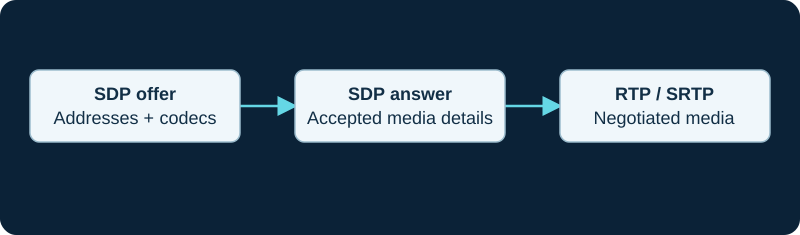
A negotiated codec does not prove packet delivery. Check both session description and actual media packets.
Questions to answer in a trace
Identify the address and port offered for audio, the permitted formats and the accepted direction. Determine which participant sent each description. For a PBX with two call legs, inspect both negotiations rather than assuming the same codec and address pass unchanged through the system.
An address can be syntactically valid but unreachable from the peer. Private addressing advertised toward an unrelated carrier is a topology problem even when the SIP exchange itself succeeds.
Hold and renegotiation
A call can change its media parameters after initial setup. Hold, transfer and network changes can trigger a new negotiation. A trace that stops at the first answer can miss the point where sound disappeared.
Compare the last successfully applied description with the current one. Look for changed destination, direction or format, then confirm whether packets follow that negotiation.
Keep the conclusion bounded
An accepted codec does not prove usable audio at the speaker. It establishes a negotiated format under the protocol. Verify packet delivery and endpoint behavior separately. Preserve a sanitized complete exchange when asking for help, including the offer and answer relevant to the failure.
Sources & applicability
Primary references for the technical details above. Operational examples and planning checklists are VoIP.info editorial guidance.