Two conversations happen at once
A voice call has a control conversation and a media conversation. In a SIP system, signaling requests establish, change and end the session. Audio commonly travels as RTP packets. They can follow different network paths, use different ports and fail independently.
Imagine an employee calling a customer through an office PBX. The phone asks the PBX to place a call. The PBX selects an authorized outbound route and communicates with a carrier. Once the call is answered, media flows along the negotiated path. Some systems relay media through the PBX; others permit a more direct path where topology and policy allow it.
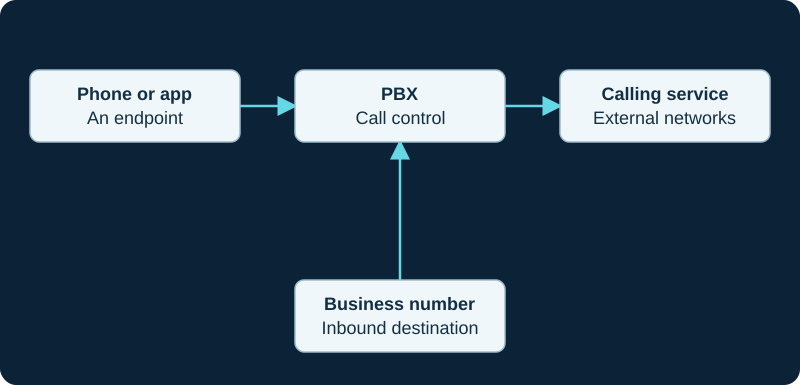
A simplified logical view. A hosted service may combine PBX and carrier functions; actual signaling and media paths can differ.
From microphone to speaker
The sending endpoint encodes speech into a codec and groups samples into packets. The receiver uses a small playout buffer to absorb variation in arrival times. A larger buffer can smooth uneven delivery, but adds delay. Missing or late packets can produce gaps or distortion.
A call's negotiated codec is not necessarily the same on every leg. A PBX or carrier may transcode between legs, which consumes processing resources and can affect audio quality. A wideband desk phone cannot force a narrowband external telephone connection to become wideband.
Diagnose the right part
A registration failure concerns reachability, identity or registrar behavior before an ordinary incoming call can be delivered. A call that connects with one-way audio points toward media negotiation or delivery. A call that reaches the wrong department points toward routing and numbering.
Record the time, calling and called numbers, direction and exact symptom. That simple incident record is more useful than changing codecs, firewall settings and routes together. Change one justified setting at a time and retain a rollback path.
Make the paths visible
Document where signaling terminates and where media is expected to flow at each site. Include VPNs, carrier borders and NAT. Revisit the drawing when moving the PBX into a VPS: a network diagram for an on-premises PBX may no longer describe the traffic.
Sources & applicability
Primary references for the technical details above. Operational examples and planning checklists are VoIP.info editorial guidance.