Locate the degradation
Record which participant hears distortion and whether the symptom is gaps, bursts or a robotic sound. Compare wired and wireless access where available. Note whether the problem coincides with uploads, backups or busy periods.
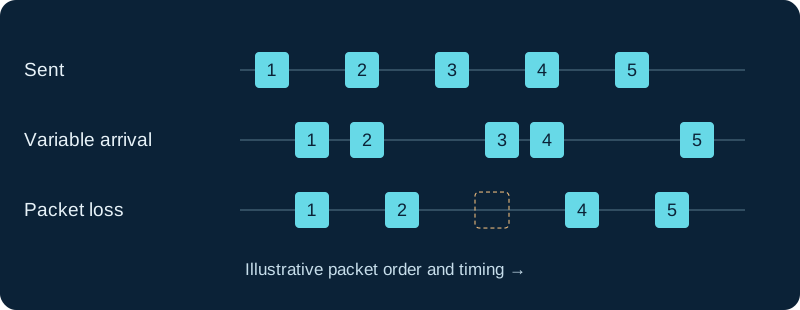
Illustration, not measured data. A jitter buffer trades playback delay against late-packet loss; it cannot recreate every missing packet.
Measure the relevant path
Inspect packet loss and arrival variation at the receiver or PBX leg that corresponds to the complaint. A clean ping to a nearby router does not establish a healthy carrier media path. A speed test outside the incident window may miss the bottleneck entirely.
Check interface errors, wireless contention and uplink queueing. On a self-hosted PBX, review CPU and storage behavior when recording or transcoding load rises. Do not assume every audio impairment originates on the public internet.
Test one hypothesis
Move one test endpoint to a known-good wired connection, or repeat a controlled call while the suspected upload is stopped. Use the comparison to localize the issue. Apply QoS at the actual controlled bottleneck when justified, preserving capacity for other critical traffic.
Re-test at peak
Confirm improvement during representative load, not only after rebooting an idle network. Keep codec and jitter-buffer changes documented; a larger buffer can add noticeable delay. Repeat a transferred call if the media route changes after transfer.
Sources & applicability
Primary references for the technical details above. Operational examples and planning checklists are VoIP.info editorial guidance.
- IETF RFC 3261 — SIP, including linked updates ↗
- IETF RFC 3550 — RTP and RTCP ↗
- Asterisk res_pjsip configuration ↗
Examples require adaptation to your topology. No live PBX or hardware testing is claimed.