80 kbit/s per call; 0.8 Mbit/s before allowance.
Plan upload and download separately. Link, VPN and encryption overhead are excluded.
What the calculator measures
The result estimates a continuous audio stream on one network link. It adds codec payload to the assumed IP, UDP and RTP headers, then multiplies by simultaneous calls. Upload and download are separate requirements: do not add them together and compare the result with only an upload rating.
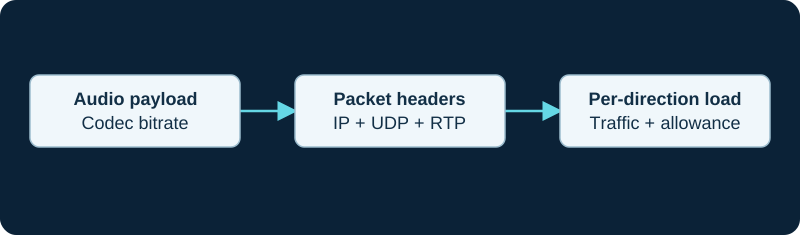
The calculator estimates IP-layer traffic in each direction. Link framing, tunnels, SRTP and unrelated traffic are outside this model.
Formula and assumptions
Per-call kbit/s = payload kbit/s + header bytes × 8 × packets per second ÷ 1,000. Packets per second = 1,000 ÷ packet duration in milliseconds. This model uses 40 header bytes for IPv4 or 60 for IPv6, assuming standard IP, UDP and RTP headers without options or extensions.
G.711 uses a 64 kbit/s payload. The G.729 option assumes 8 kbit/s. Opus is modeled at an editable-choice assumption of 32 kbit/s, not a claim that every Opus call uses that rate. Packet duration is a planning input; your endpoint and codec must support the intended value.
Worked example
Ten G.711 calls at 20 ms packet duration over IPv4 use 80 kbit/s each at the IP layer: 64 kbit/s payload plus 16 kbit/s headers. The aggregate is 0.8 Mbit/s in each direction. Adding a chosen 25% allowance gives 1 Mbit/s in each direction.
That allowance is an editorial planning scenario. It does not certify a link or account for unrelated traffic sharing the connection.
What is excluded
Ethernet framing, VLAN tags, tunnels, SRTP overhead, RTP extensions, RTCP, signaling and retransmission behavior are excluded. Silence suppression is not credited. Actual wireless airtime and VPN overhead can be materially different from this IP-layer estimate.
For a PBX relaying several legs across one interface, count the streams that cross that interface. Validate busy-hour behavior, packet loss and queueing after estimating capacity.
Sources & applicability
Primary references for the technical details above. Operational examples and planning checklists are VoIP.info editorial guidance.