Measure the experience and path
Record whether people talk over each other or hear delayed responses, and which site or route is affected. Round-trip ping latency is not identical to one-way mouth-to-ear delay. Codec processing, packetization and playout buffering also contribute.
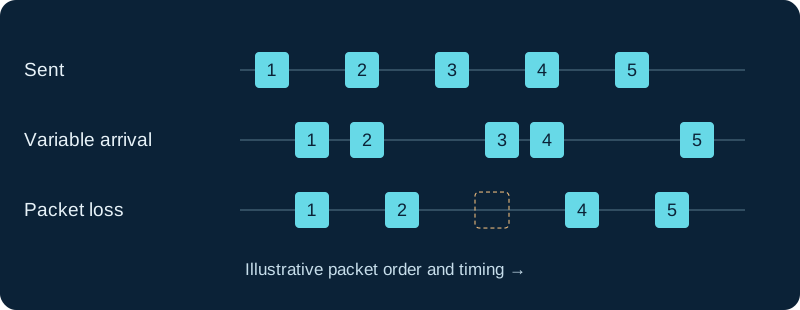
Illustration, not measured data. A jitter buffer trades playback delay against late-packet loss; it cannot recreate every missing packet.
Look for queueing
Compare an idle call with a call during a controlled upload or other busy period. If delay rises sharply under load, inspect the actual bottleneck and queue management. A large nominal bandwidth figure does not prevent a saturated upload queue.
Check whether a VPN, distant PBX or unnecessary media relay changes the route. Do not remove a security boundary merely to shorten a path without assessing the full design.
Review endpoint processing
Inspect packet duration and jitter-buffer behavior where supported. Increasing a buffer can smooth uneven arrivals but adds delay. Transcoding and conference processing can add work on a PBX even when the network itself is stable.
Validate the trade-off
Compare sound quality and conversational delay after one justified adjustment. Test during peak load and with the actual remote locations. Keep both timing and packet-loss observations; reducing buffering too far can make audio worse while making the delay statistic look better.
Sources & applicability
Primary references for the technical details above. Operational examples and planning checklists are VoIP.info editorial guidance.
- IETF RFC 3261 — SIP, including linked updates ↗
- IETF RFC 3550 — RTP and RTCP ↗
- Asterisk res_pjsip configuration ↗
Examples require adaptation to your topology. No live PBX or hardware testing is claimed.