Write the menu before configuring it
An IVR maps caller digits to PBX destinations. Draft the spoken choices and the routes together: for example, 1 for sales, 2 for support and 0 for an attended fallback. Keep the first menu short enough that a caller can remember the choices.
A recording alone does not create the routing. System Recordings holds the audio asset; the IVR defines the digit behavior. Ensure each advertised department has a working destination before connecting the public number.
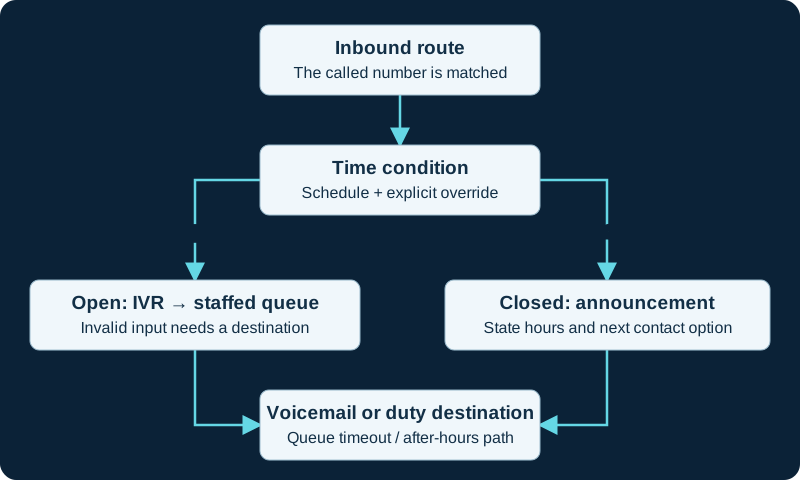
One routing design. Test holiday rules, manual overrides, invalid IVR input and queue overflow separately; the selected destinations depend on local policy.
Build and apply a small test menu
Create the prompt in System Recordings and select it in the IVR application. Add the digit-to-destination mappings, timeout behavior and invalid-input destination. Decide whether direct extension dialing is necessary; exposing arbitrary extensions is a separate access decision.
Submit and Apply Config, then route a test DID or internal test path to the menu. Avoid pointing the only business number to an untested IVR. Keep a direct-to-reception route ready as a rollback.
Exercise every branch
Press each valid digit, an invalid digit, nothing at all, and a digit during the prompt. Test from the real carrier path as well as an internal phone: local DTMF success does not establish carrier-side negotiation. Check every submenu’s return action to prevent loops.
If callers hear the menu but digits do nothing, inspect DTMF negotiation and the affected call leg. If a digit is recognized but reaches the wrong place, inspect its destination mapping. These are different failures.
Keep a reachable exit
Use an attended destination, useful mailbox or clear final announcement after retries. Hidden digit choices are discoverable and must not replace authentication. Re-record the prompt when choices change, and call the public number after every routing update.
Watch the explanation
Distinguishes the called DID from caller ID and follows inbound calls to a destination. The catch-all and exact-number examples help explain why a route matches unexpectedly.
Read applicability and editorial notes →Watch this video here
FreePBX 15 walkthrough. Our written administration baseline is FreePBX 17 on Debian 12. Review used the available transcript and primary references; audio and screen readability remain unverified.

The player loads only when you choose Watch here. Playback uses YouTube’s privacy-enhanced embed; YouTube processes playback data.
Walks a complete inbound design through weather overrides, holidays, business hours and fallback destinations. Watch before building the individual modules.
Read applicability and editorial notes →Watch this video here
Part of a FreePBX 15 series, but this lesson teaches call-flow design rather than relying on the old interface. Review used the available transcript and primary references; audio and screen readability remain unverified.

The player loads only when you choose Watch here. Playback uses YouTube’s privacy-enhanced embed; YouTube processes playback data.
Sources & applicability
Primary references for the technical details above. Operational examples and planning checklists are VoIP.info editorial guidance.
Examples require adaptation to your topology. No live PBX or hardware testing is claimed.