A schedule and a branch are different objects
A Time Group describes matching times and dates. A Time Condition selects a matched or unmatched destination using that group. For an office, the matched branch might reach reception and the unmatched branch might play a closed announcement.
Write the business timezone, weekday hours and holidays before entering ranges. Check the PBX clock and timezone. A perfectly entered schedule evaluated in the wrong timezone is still the wrong call flow.
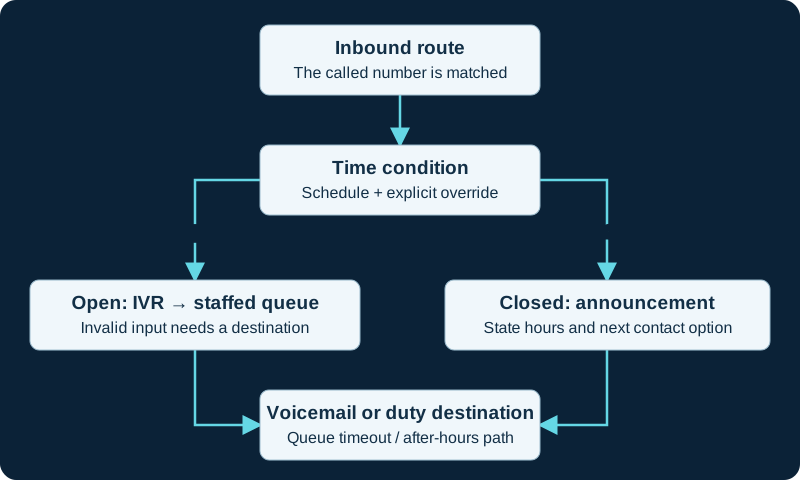
One routing design. Test holiday rules, manual overrides, invalid IVR input and queue overflow separately; the selected destinations depend on local policy.
Build an explicit schedule
Create the group and condition with descriptive names. Define ordinary open periods and holiday exclusions, then connect both destinations. Blank date fields can mean all dates; blank times combined with a date range can express exclusions. Review the installed module’s range behavior instead of using blank fields casually.
Prefer a test destination while validating a new schedule. Apply the change and inspect the condition’s current state. Keep a direct route to the previous destination for rollback.
Understand overrides
A temporary override returns to schedule behavior after the applicable span; a permanent override remains until removed. An override PIN can restrict who changes the state. The BLF indication can be inverted, so a red lamp does not inherently mean open or closed.
Label the operator’s control according to the actual configured behavior. Include reset instructions and assign an owner for holiday changes. Do not leave a permanent override as an undocumented emergency workaround.
Test boundaries and recovery
Check just before opening, within the working period, at closing and on a holiday. Avoid changing a production server’s clock to perform these tests; use an isolated system or a temporary test schedule. Test resetting an override and verify the public number from outside.
For incidents, compare clock, timezone, matching group, override state and destination in that order. The business-hours guide helps translate policy into a call-flow diagram.
Watch the explanation
Walks a complete inbound design through weather overrides, holidays, business hours and fallback destinations. Watch before building the individual modules.
Read applicability and editorial notes →Watch this video here
Part of a FreePBX 15 series, but this lesson teaches call-flow design rather than relying on the old interface. Review used the available transcript and primary references; audio and screen readability remain unverified.

The player loads only when you choose Watch here. Playback uses YouTube’s privacy-enhanced embed; YouTube processes playback data.
Builds a weekly office schedule, then divides a holiday closure into a partial first day, complete middle days and a partial final day. Useful when a single time range cannot express the schedule clearly.
Read applicability and editorial notes →Watch this video here
Uploaded October 2023; the narration identifies a FreePBX 16 system from February 2023. Check controls on FreePBX 17. Review used the available transcript and primary references; audio and screen readability remain unverified.

The player loads only when you choose Watch here. Playback uses YouTube’s privacy-enhanced embed; YouTube processes playback data.
Sources & applicability
Primary references for the technical details above. Operational examples and planning checklists are VoIP.info editorial guidance.
Examples require adaptation to your topology. No live PBX or hardware testing is claimed.