Capture a specific failed destination
Record the digits entered, the extension, timestamp and error heard. Compare another permitted destination and another extension. One failing international destination is a different problem from every internal and external call failing.
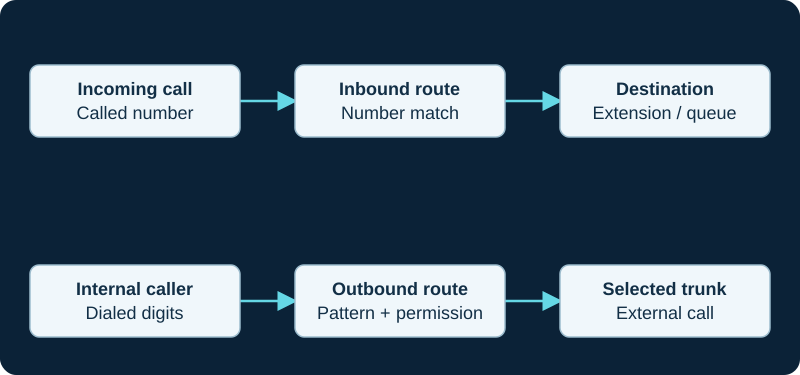
A working outbound call does not prove inbound number routing. Diagnose the direction and the matching rule independently.
Check the local route
Inspect the selected context or FreePBX outbound route, its order and digit transformation. Confirm the extension is allowed to use it. A handset may apply its own local dial plan before sending anything, so verify that an INVITE actually leaves the endpoint.
If the PBX never sends a carrier request, changing trunk authentication cannot repair the local routing decision. Review the loaded configuration rather than only the saved form.
Interpret carrier rejection
If a request reaches the carrier, inspect its response and documented policy. Calling permissions, caller-ID authorization, account state and number format can all matter. Avoid diagnosing an isolated 403 as definitely an incorrect password.
Validate permissions as well as success
Test an intended destination and a deliberately prohibited one after the change. Keep high-cost restrictions intact. Confirm caller identity and audio on a successful call, and review fallback trunks for different formatting or charging behavior.
Sources & applicability
Primary references for the technical details above. Operational examples and planning checklists are VoIP.info editorial guidance.
- IETF RFC 3261 — SIP, including linked updates ↗
- IETF RFC 3550 — RTP and RTCP ↗
- Asterisk res_pjsip configuration ↗
Examples require adaptation to your topology. No live PBX or hardware testing is claimed.