Control requires an operating plan
Identify why you need control
Self-hosting can be useful when the organization needs custom routing, a particular endpoint estate or deeper integration with internal systems. Write down those requirements before choosing Asterisk or FreePBX. Distinguish necessary control from settings that merely look interesting. Someone must remain responsible for the system when the original installer is unavailable.
Capabilities and responsibilities
Evaluate extension management, trunks, inbound routes, outbound permissions, queues and integration interfaces. Keep a small, documented configuration and a change history. Separate the PBX from the SIP trunk service: numbers, PSTN access and provider capacity remain external dependencies. Test call behavior after changes, including denied destinations and unavailable routes, in an authorized environment.
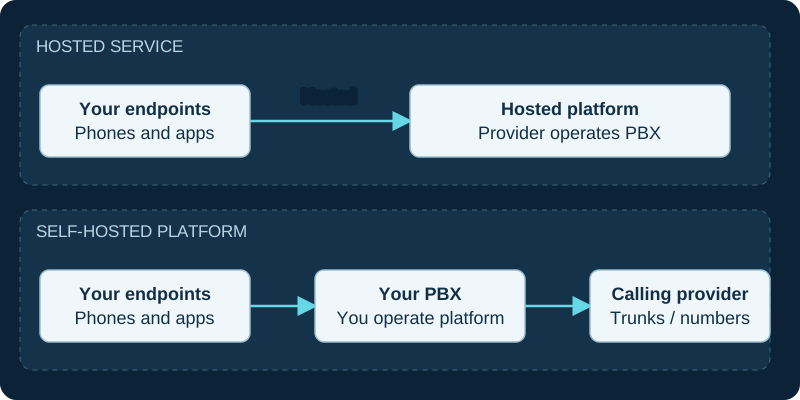
Operating responsibility changes. Both approaches still need endpoint, network and continuity planning.
Network and security requirements
Define the signaling and media paths, remote-access design, DNS, certificates and firewall policy. Protect administrative interfaces and restrict calling permissions according to the actual requirement. Monitor both technical availability and unusual calling behavior. A registered endpoint is not proof that media, inbound routing or billing controls work correctly.
Endpoints and infrastructure
Choose phones with documented provisioning support and maintain configuration ownership outside individual device screens. Size compute, storage, power and connectivity around the workload, including recording and recovery. Keep replacement hardware and credential recovery procedures practical. An automatic backup is useful only when the organization can restore it onto a known target.
Compare self-hosting with hosted service
Include administrator time, upgrades, monitoring, incident response and restore exercises in the cost comparison. Hosted service may be a better operational fit where the organization has no PBX operator. Self-hosting may provide useful control where that skill and responsibility already exist. Neither model removes the need to manage users, endpoint configuration and telephone-number continuity.
Mistakes and buyer research
Avoid exposing a fresh PBX directly to the internet with broad defaults or assuming the lowest trunk rate determines total cost. Ask trunk suppliers about DID coverage, permitted calling destinations, concurrency, failover, porting and emergency-calling support. Define escalation ownership across the PBX operator, network team and carrier before the first outage. Schedule a restore exercise before depending on the system.
Use these resources next
Self-hosted VoIP: an operating plan →Asterisk →FreePBX →SIP trunking: numbers, capacity and operational control →FreePBX restore testing →Hosted vs self-hosted VoIP cost calculator →Carry your required call flow, endpoint list and support responsibilities into provider comparison. A listed provider is a research starting point; verify fit and current terms for your configuration.
Technical sources and further reading
The planning questions are VoIP.info editorial guidance. These references support the underlying technologies; capabilities and versions should be checked for your deployment.