Choose a topology before an installer
A self-hosted system combines call-control software, endpoints and usually a SIP carrier for outside calling. Decide whether the PBX belongs on premises or in a hosted VM. An office PBX can keep local calls local; a cloud PBX can simplify access across sites but adds reliance on internet paths. Neither choice automatically solves remote-phone security.
Draw the phone-to-PBX and PBX-to-carrier paths separately. Identify who owns public addressing, firewall policy, DNS and certificates. Record which systems need access to management interfaces and which only need call signaling or media.
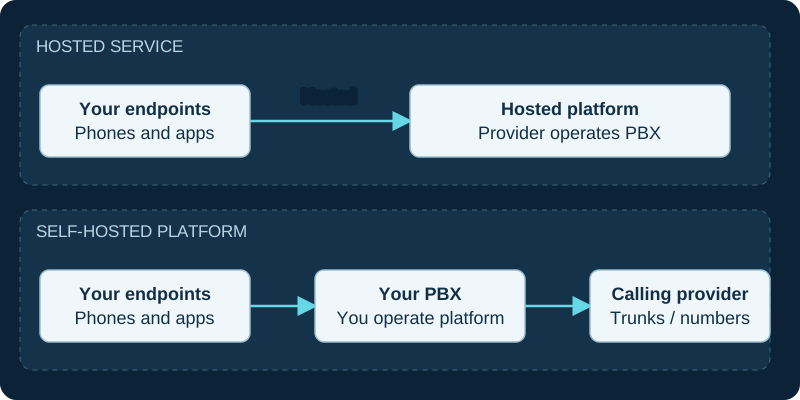
Operating responsibility changes. Both approaches still need endpoint, network and continuity planning.
Establish a bounded first deployment
Use an isolated lab or a restricted network. Begin with two extensions and internal calls. Verify two-way sound, hangup, hold and transfer before introducing a trunk. Avoid connecting paid outbound service to a permissive dialplan written for experiments.
The standalone tutorial baseline here is Asterisk 22 LTS. The FreePBX path uses FreePBX 17 on Debian 12 and the Asterisk version supplied or recommended by that installation path. Do not replace FreePBX's generated configuration with standalone examples.
Budget for the workload
Extension count is not server sizing. Simultaneous calls, transcoding, recording, conferences, logging and other applications influence resource needs. Record a peak-load profile and validate it on the intended environment. A published installer minimum is not a production capacity guarantee.
Store backups away from the PBX and protect their credentials. Define how much configuration or recording loss is tolerable and how quickly service must recover. Restore into an isolated environment so a test system cannot accidentally register trunks or place chargeable calls.
Before carrying business calls
Name an operator and backup operator. Limit outbound permissions, arrange spend alerts with the carrier, document incoming failover and verify emergency-service arrangements. Keep a known-good configuration and rollback plan for each change. PBX Lab explains our evidence labels; installation guides should be treated as documented starting points until you validate your own deployment.
Sources & applicability
Primary references for the technical details above. Operational examples and planning checklists are VoIP.info editorial guidance.