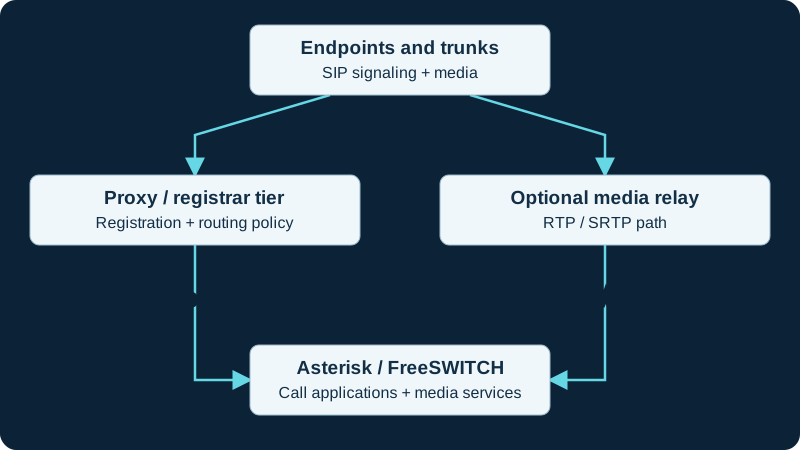
Build the signaling layer deliberately
OpenSIPS is a modular SIP proxy/server used in communications platforms for routing, registration, presence and other signaling functions. Its module ecosystem includes load balancing, mid-registrar behavior and integration with media relays. A module list is a set of building blocks, not a complete secure deployment. Start by deciding which services belong at the edge and which belong in an Asterisk, FreeSWITCH or other application tier. Keep business call behavior and endpoint provisioning ownership explicit.
Use a named documentation branch
The downloads page reviewed September 7, 2026 lists 4.0 as a stable branch and 3.6 as the LTS branch. This introductory cluster uses the 3.6 reference. Do not copy configuration functions from development or another major branch without checking compatibility. Read registration and load distribution and resilience and media boundaries. Both assume familiarity with SIP dialogs, transactions and NAT.
Validate the platform lifecycle
Test endpoint enrollment, registration refresh, new calls, in-dialog requests and cleanup. Then exercise a failed application node and a reconnecting endpoint. Inspect signaling and media independently. Do not infer tenant isolation, topology privacy or seamless failover from a feature name. Define the requirement, configure the responsible components and retain the observed result. The foundation here is documentation-based and does not claim a benchmark or a lab-verified deployment.
Sources & applicability
Primary references for the technical details above. Operational examples and planning checklists are VoIP.info editorial guidance.
Examples require adaptation to your topology. No live PBX or hardware testing is claimed.