Inbound routes choose a destination
An inbound route matches delivered call information and sends the call to a destination such as an extension, ring group or IVR. The DID must match the format the carrier actually supplies. A number displayed on an invoice is not necessarily the exact signaling representation received by the PBX.
Caller-ID matching is an additional filter when used. It is not the destination number. Inspect a redacted incoming call record before changing match fields based on guesswork.
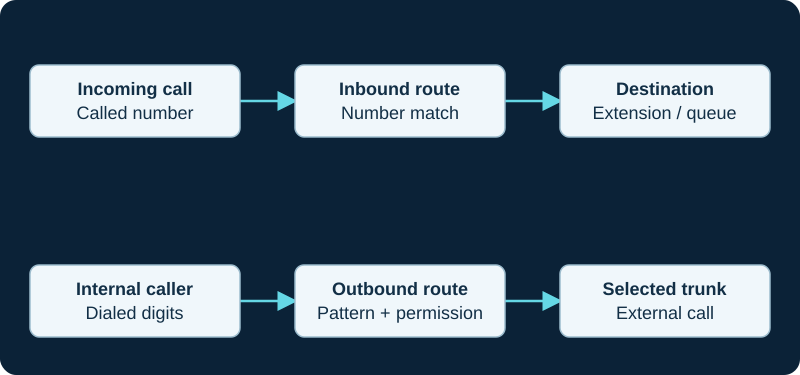
A working outbound call does not prove inbound number routing. Diagnose the direction and the matching rule independently.
Outbound routes select a calling path
An outbound route evaluates dialed patterns and chooses a trunk sequence under configured policy. Pattern normalization can add or remove digits. Write down the expected transformation with a concrete example before saving it.
Review route ordering and permissions. A broad route can intercept a more specific intention. A fallback trunk can have different caller-ID rules, permitted destinations and charges. Test the actual fallback condition rather than assuming any failure triggers the next trunk.
Use a small test matrix
Test an allowed destination, a deliberately disallowed destination, the incoming DID and an after-hours path. Confirm the observed trunk and final destination, not only whether the caller heard ringing.
Submit and apply changes through FreePBX. If the runtime behavior differs, inspect whether the latest configuration was applied and whether another matching rule explains the call.
Keep routing understandable
Name routes by purpose and record their number formats. Separate emergency-service requirements and special devices into explicit planning with the carrier. Retain a rollback copy before restructuring working routes. A future administrator should be able to predict a call's path without trying random patterns in production.
Watch the explanation
Distinguishes the called DID from caller ID and follows inbound calls to a destination. The catch-all and exact-number examples help explain why a route matches unexpectedly.
Read applicability and editorial notes →Watch this video here
FreePBX 15 walkthrough. Our written administration baseline is FreePBX 17 on Debian 12. Review used the available transcript and primary references; audio and screen readability remain unverified.

The player loads only when you choose Watch here. Playback uses YouTube’s privacy-enhanced embed; YouTube processes playback data.
Explains conference numbers, separate user and leader PINs, leader wait/leave behavior and the inbound route that makes a room reachable. Useful preparation for testing who can enter and when a conference ends.
Read applicability and editorial notes →Watch this video here
Uploaded in October 2024, but the narration identifies FreePBX 16 as configured in June 2023. Use our FreePBX 17 guide alongside it. Review used the available transcript and primary references; audio and screen readability remain unverified.
The player loads only when you choose Watch here. Playback uses YouTube’s privacy-enhanced embed; YouTube processes playback data.
Sources & applicability
Primary references for the technical details above. Operational examples and planning checklists are VoIP.info editorial guidance.
Examples require adaptation to your topology. No live PBX or hardware testing is claimed.