Record the whole repeating cycle
Capture enough time to include one complete registration cycle and its next repetition. Write down the phone’s uptime, registrar, transport and the moment its display changes state. A loop is a pattern over time; a screenshot of one REGISTER or one error response cannot establish it.
Separate three observations: registration never reaches success, registration succeeds and then expires, or the server retains a binding while the phone reports failure. Start with the existing registration guide if the basic exchange is unfamiliar.
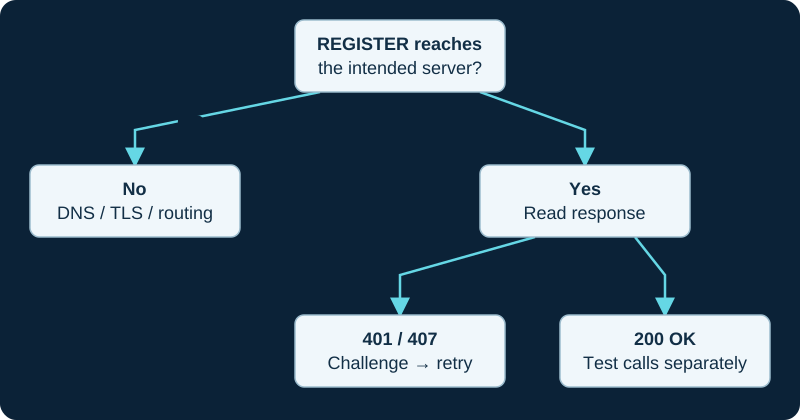
A first 401 challenge can be normal. Read the response to the authenticated retry before changing credentials.
If authentication never settles
Compare the first challenge with the subsequent authorized request and response. A challenge alone is expected in authenticated registration. Look for a wrong username or realm, a changed credential, or a phone receiving a different template than intended.
Check one endpoint against the authoritative provisioning record. Do not change the trunk password, phone secret and server authentication settings together. Keep challenge material and authentication headers out of public incident reports.
If success is followed by another registration
Read the expiration granted for the matching Contact in the successful response. Registration is refreshed before that binding expires; a repeat at a supported refresh interval is not automatically a defect. Compare the actual interval with the phone’s settings and server policy.
If the source address, contact or phone uptime changes at each cycle, investigate network reconnection or device restart. If two devices appear to replace each other’s destination, inventory their account assignments and the server’s allowed-contact policy before adding more retries.
Prove reachability during the gap
Call the extension during the period when it claims to be unavailable. Record whether the server sends the INVITE to the expected current destination and whether it arrives at the phone. This separates stale display state from an unusable registration.
After a narrow correction, observe more than one complete refresh cycle and repeat an inbound call after idle time. Record the accepted interval and contact behavior. Avoid an aggressive retry setting that merely generates more traffic while hiding the original timing evidence.
Sources & applicability
Primary references for the technical details above. Operational examples and planning checklists are VoIP.info editorial guidance.
Examples require adaptation to your topology. No live PBX or hardware testing is claimed.