The receptionist workflow comes first
Design around the person answering
Reception is a real-time coordination role. The receptionist needs to identify a caller, see an appropriate destination and recover gracefully when a transfer is not answered. Observe the busiest half hour and record simultaneous calls, repeat callers, paging needs and the frequency of interruptions. A nominal feature list says little about how many steps it takes to complete this work.
Features worth piloting
Prioritize attended transfer, clearly distinguishable held calls, useful busy-lamp or presence state, directory search and a defined no-answer return. Decide whether calls wait in a queue or ring a backup group when reception is occupied. Presence is a hint, not proof that a colleague can take the call. Test the actual transfer sequence rather than asking only whether transfer is supported.
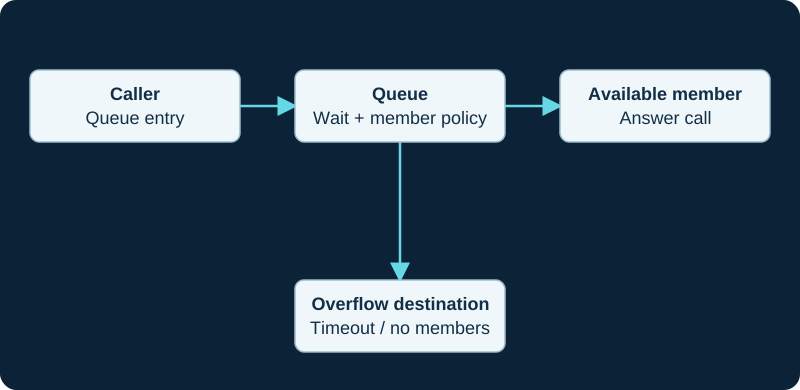
Member availability, caller waiting policy and overflow routing are separate decisions. Check the experience when no members are available.
Network and power requirements
Prefer a stable wired connection for a fixed reception position and budget power for the phone and its accessories. Check switch capacity, cabling and backup power for the complete answering path. An expansion module can change the power requirement; verify the manufacturer’s supported combination instead of counting only the base phone.
Endpoint requirements
Compare screen readability, key layout, headset support and the supported number of expansion modules. Ask the receptionist to answer, hold, consult, transfer and retrieve a call on the proposed phone or console. Confirm that the platform provisions the required keys and states. Hardware support for an accessory does not prove that a particular hosted service configures it.
Hosted or self-hosted?
A hosted receptionist console may reduce administration if it supports the actual daily workflow and endpoint combination. A self-hosted PBX offers detailed routing control but leaves extension state, key provisioning, updates and troubleshooting with your operator. Choose a system the receptionist and the administrator can both operate confidently.
Common mistakes and buyer research
Avoid buying the largest display before validating transfer recovery, or replacing familiar keys with unexplained softkeys on cutover day. Ask who answers during lunch, whether unanswered transfers return to the original person, and what happens if the receptionist logs out. Record an agreed call-flow script and use it as the comparison demonstration for each shortlisted provider.
Use these resources next
Receptionist phones and expansion keys →Compare documented phones →Ring groups: shared answering without a waiting queue →Call queues: waiting, agents and overflow →PoE budget calculator →Browse researched providers →Carry your required call flow, endpoint list and support responsibilities into provider comparison. A listed provider is a research starting point; verify fit and current terms for your configuration.
Technical sources and further reading
The planning questions are VoIP.info editorial guidance. These references support the underlying technologies; capabilities and versions should be checked for your deployment.