Queues are an operating process
Define the service promise
Write down which team owns each queue, when it is staffed and what a caller should experience if nobody is available. Distinguish a brief wait from a request that needs a callback or an asynchronous ticket. Queue technology cannot compensate for an unanswered destination or an escalation rule nobody owns. Observe the arrival pattern and the work agents do after the conversation.
Queue and agent requirements
Evaluate agent login and pause, wrap-up behavior, overflow, callback options and supervisor visibility. Define whether agents can receive direct calls while serving a queue. Test all-agents-busy, no-agents-logged-in and closed-hours cases separately. Recording, monitoring and reporting need documented access roles; managers should understand exactly what each metric counts.
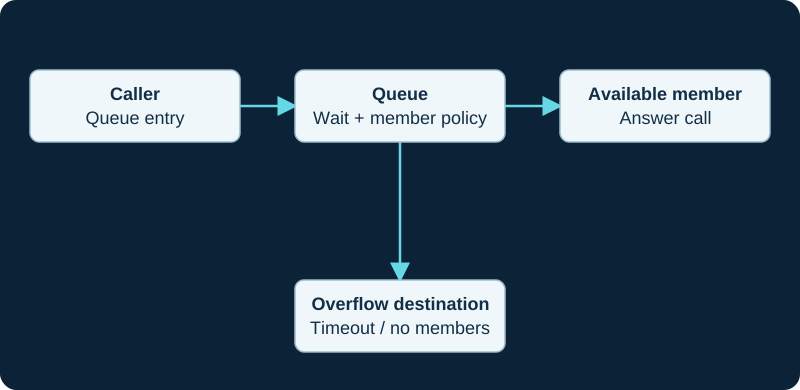
Member availability, caller waiting policy and overflow routing are separate decisions. Check the experience when no members are available.
Network and continuity requirements
Plan for concurrent customer calls, consultation legs and any recording or transcription traffic. Measure a busy support period instead of using a quiet demonstration. Agree on an alternate destination during an outage and verify who can activate it. A redundant network connection does not by itself replace an unavailable provider queue or restore a dropped customer conversation.
Agent endpoints
Prioritize clear headset audio, dependable mute and call controls, and a client layout that keeps the customer record accessible. Test transfer and hold while the ticketing application is under ordinary load. If agents share workstations, prove login, logout and audio-device selection at shift change so one person does not inherit another’s calls.
Hosted or self-hosted?
A hosted queue may be sufficient for straightforward support, while more complex routing and reporting can require a separate contact-center product. Verify the actual product boundary. Self-hosted queues offer control but leave agent policy, reporting interpretation, recording storage and incident response with the organization. Compare staffing and recovery responsibilities alongside features.
Mistakes and research questions
Avoid setting a long queue timeout with nowhere useful to send the caller. Ask how abandoned calls, callbacks, transfers and short disconnects appear in reports. Reconcile a sample of real call events with the dashboard before adopting a performance target. Test a supervisor’s escalation path and establish a recovery owner for failed recordings or missing call records.
Use these resources next
Call queues: waiting, agents and overflow →FreePBX queues and agent operations →Planning business call recording →Call recording storage calculator →VoIP network failover →Browse researched providers →Carry your required call flow, endpoint list and support responsibilities into provider comparison. A listed provider is a research starting point; verify fit and current terms for your configuration.
Technical sources and further reading
The planning questions are VoIP.info editorial guidance. These references support the underlying technologies; capabilities and versions should be checked for your deployment.