Count streams on the relevant interface
Codec payload rate is only part of the traffic. Each packet also carries headers, and the number of packets per second depends on packet duration. A PBX relaying media can carry several streams for one conversation; map the path before counting calls.
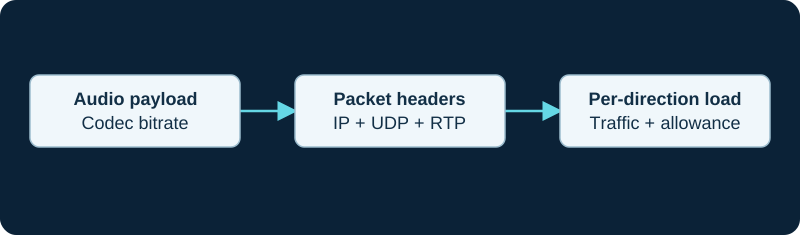
The calculator estimates IP-layer traffic in each direction. Link framing, tunnels, SRTP and unrelated traffic are outside this model.
Work a concrete example
G.711 at 64 kbit/s with 20 ms packets adds 16 kbit/s of standard IPv4/UDP/RTP headers, giving 80 kbit/s in each direction at the IP layer. Link framing, encryption and tunnels add more. Use the bandwidth calculator to vary those explicit assumptions.
Find the limiting direction
An asymmetric internet connection may have ample download capacity while uploads saturate. Backups or file synchronization can contend with outgoing audio. Measure during the business's busy interval and include remote-phone or VPN traffic that shares the uplink.
Validate beyond throughput
A nominal capacity estimate cannot establish low loss or predictable delay. Observe quality under representative load and check queueing at the actual bottleneck. Keep an allowance for unrelated traffic and growth rather than reserving the entire advertised connection for calculated voice payload.
Sources & applicability
Primary references for the technical details above. Operational examples and planning checklists are VoIP.info editorial guidance.