Collect carrier-specific facts
Obtain the provider's current PBX guide and confirm the account type. Record signaling destinations, media networks, authentication method, supported transports, codecs, number format and caller-ID policy. Do not copy a working configuration for a different carrier and assume that changing the password is sufficient.
Choose a noncritical test number and a limited outbound calling allowance. Keep the carrier's escalation contact and a way to suspend service available outside the PBX.
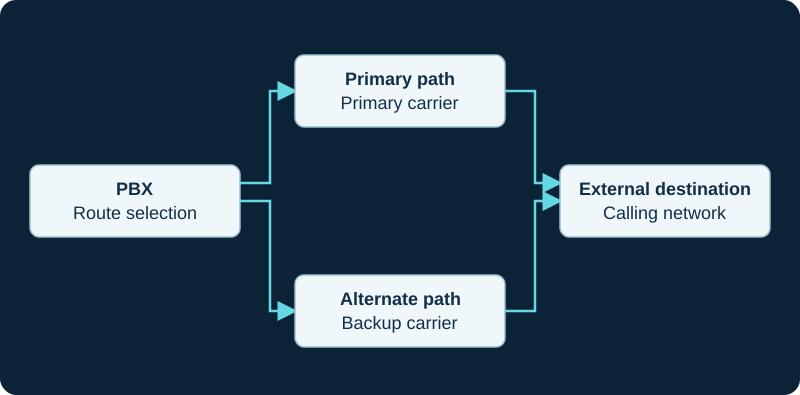
New-call recovery and active-call survival are different tests. Inbound number failover needs a provider-side routing plan.
Separate the object responsibilities
An endpoint describes the trunk's call behavior. An AOR can describe a static destination. An auth object can support challenged outbound requests. A registration object is needed only when the carrier's registration flow requires it. Incoming identification and dialplan routing still need their own review.
Place carrier-originated calls in a restricted inbound context. That context should reach known business destinations and should not inherit unrestricted outbound dialing. Authentication proves an identity under configured rules; it does not justify granting every routing privilege.
Route deliberately
Normalize incoming and outgoing numbers according to the carrier's actual format. Start with explicit test destinations instead of a broad catch-all pattern. Record how a forwarded external call uses trunk capacity and caller identity.
Inspect the running endpoint and registration state, then follow a bounded INVITE exchange. A registered trunk can still fail because the chosen route, permitted destination or media negotiation is wrong.
Accept both call legs
Test incoming and outgoing calls, two-way audio, DTMF, hold, transfer, caller identity and recovery after a controlled interruption. Arrange emergency-service configuration and validation directly with the carrier. Keep the provider instructions and your redacted acceptance record with the PBX backup. This guide supplies a configuration process, not an unverified provider-specific recipe.
Sources & applicability
Primary references for the technical details above. Operational examples and planning checklists are VoIP.info editorial guidance.
- Asterisk: outbound registration ↗
- Asterisk: PJSIP object relationships ↗
- Asterisk: PJSIP configuration examples ↗
Examples require adaptation to your topology. No live PBX or hardware testing is claimed.