Asterisk acting as a registering client
With outbound registration, Asterisk sends REGISTER requests to another registrar. The registration object describes that relationship. It is separate from the endpoint that handles calls and the rules used to associate incoming traffic with an endpoint.
This distinction matters when a status screen says registered but calls fail. Registration success verifies the registrar accepted a binding under its policy. It does not prove a dialplan route exists, caller ID is permitted or a usable codec was negotiated.
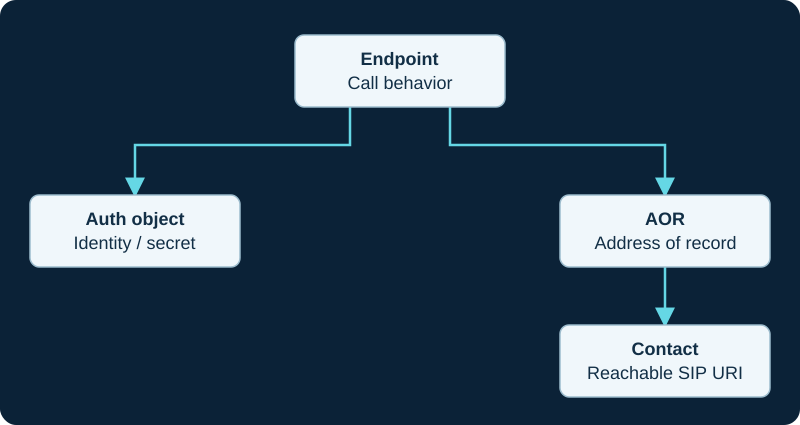
Logical configuration relationships, not a complete pjsip.conf. An outbound trunk can use a separate outbound-auth relationship.
Map the carrier's required identities
Record the server URI, client URI and any authentication identity from the carrier's documentation. These values need not be identical. Preserve transport and proxy requirements as separate settings rather than guessing from a hostname.
A registration can use outbound authentication when challenged. Repeated failure should prompt a comparison of the configured identities, supported challenge behavior and carrier account state. Avoid aggressive retry loops that trigger account protection or unnecessary traffic.
Observe status and the exchange
Use pjsip show registrations and inspect the relevant registration. If the system never sends a request, examine object loading and destination resolution. If a request is sent but no response returns, investigate reachability. If a response rejects it, use that specific response and the carrier's logs to narrow the reason.
A successful challenge sequence is not an error merely because a 401 appeared before the final success. Follow the complete exchange.
Test delivery and recovery
After registration succeeds, make an incoming test call and verify the intended destination. Make an outgoing call independently. Check recovery after a controlled network interruption and record the observed timing. Do not assume that registration failover also implements incoming-number failover at the carrier.
Sources & applicability
Primary references for the technical details above. Operational examples and planning checklists are VoIP.info editorial guidance.
Examples require adaptation to your topology. No live PBX or hardware testing is claimed.