Keep the local baseline
Record the working local account and firmware before moving the phone. If the same endpoint fails remotely, identify what changed: DNS, NAT, firewall, VPN, address family or provisioning access. Do not immediately rotate a secret that was just demonstrated to work.
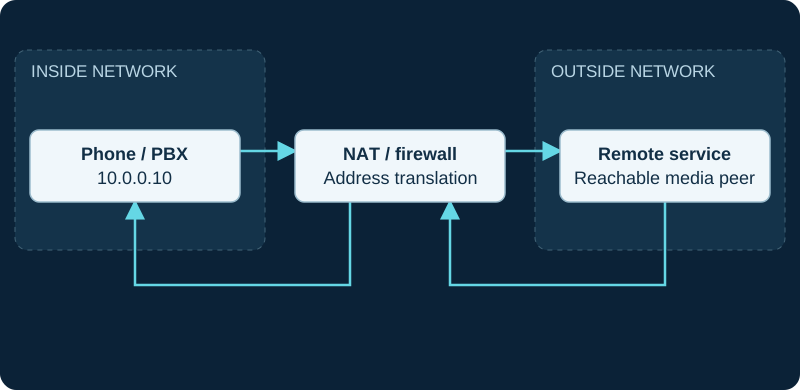
10.0.0.10 is an illustrative private address. Both directions traverse the NAT/firewall; signaling success does not validate SDP media reachability.
Separate registration and media
A remote phone that receives no registration reply needs a signaling-path investigation. A registered phone with one-way sound needs media negotiation and delivery checks. A successful outgoing call with failed incoming delivery can indicate an unreachable stored contact.
Inspect the VPN route if one is used. Split routing or overlapping private subnets can send some PBX traffic to the wrong interface. Public-address workarounds from a non-VPN configuration may no longer fit.
Preserve security boundaries
Use the organization's supported remote-access design and current device guidance. Opening management services to the internet is not required merely because a handset needs calling access. Limit carrier and endpoint traffic according to the actual topology.
Verify persistence
Test incoming, outgoing, hold and transfer, then restart the phone and exercise a controlled network reconnect. Record recovery timing and contact changes. A single call immediately after manual setup does not validate an unattended remote worker's daily operation.
Sources & applicability
Primary references for the technical details above. Operational examples and planning checklists are VoIP.info editorial guidance.
- IETF RFC 3261 — SIP, including linked updates ↗
- IETF RFC 3550 — RTP and RTCP ↗
- Asterisk res_pjsip configuration ↗
Examples require adaptation to your topology. No live PBX or hardware testing is claimed.