Record what the caller should hear
Identify the missing sound: local ringback, a carrier announcement, a queue prompt or a tone from a gateway. Note whether normal audio starts once the destination answers. If only pre-answer audio is missing, that boundary is more useful than a general “no audio” report.
Test with one known destination and one alternate destination. Capture from the initial INVITE through the final answer or failure so the provisional exchange is present.
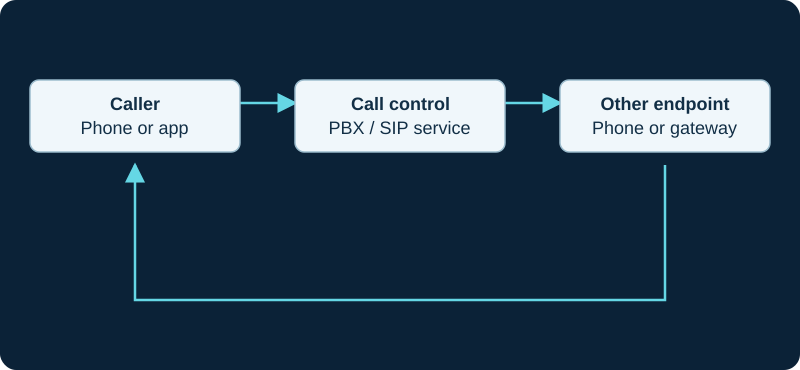
Illustrative topology: direct RTP is shown below. Many PBXs and session border controllers anchor media instead.
Read provisional signaling and SDP together
Inspect the 180 or 183 responses and any associated SDP, then compare what each PBX leg received. A provisional status code alone does not demonstrate that usable early media arrived. Determine whether the expected audio source actually transmitted RTP toward the negotiated receiver.
Where reliable provisional responses are negotiated, inspect the 100rel, RSeq and PRACK/RAck exchange. A repeated reliable response and an absent or mismatched acknowledgement identify a signaling problem that opening more RTP ports will not explain.
Compare the two sides of the PBX
If the carrier sends an announcement and RTP reaches the PBX, inspect what the PBX sends to the phone during the same interval. A PBX may generate tones or handle early media differently on its two legs. Look at the configured application behavior and the actual negotiation rather than assuming transparent forwarding.
If no RTP arrives from the expected source, move the capture boundary outward. If packets arrive at the phone but nothing plays, investigate its early-media handling and accepted stream.
Verify the pre-answer and answered paths
Make the narrow change supported by the failed boundary: provisional-response compatibility, an application’s progress behavior or the media path. Do not force every call to answer early solely to manufacture ringback; that can change application and carrier behavior.
Retest an unanswered call, a carrier announcement and a normally answered call. Check that the caller hears the right sound before answer and two-way audio afterward. Save the relevant provisional messages with the observation, without claiming a packet capture reproduces the listener’s experience by itself.
Sources & applicability
Primary references for the technical details above. Operational examples and planning checklists are VoIP.info editorial guidance.
Examples require adaptation to your topology. No live PBX or hardware testing is claimed.