Identify who ended the call
Find the first terminating action in the PBX log and SIP exchange. Record the call duration, hold state and last received media time. An endpoint that receives BYE from the PBX may be showing a consequence, while the PBX’s earlier log explains the reason.
Do not classify every repeatable disconnect as an RTP timeout. A missing SIP acknowledgement, session refresh problem or an application’s duration limit can produce a similar user complaint.
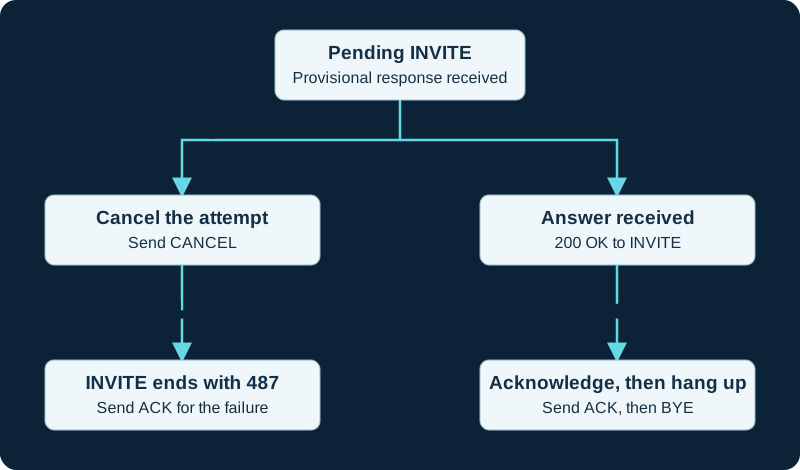
Simplified caller-side decision. The CANCEL and BYE requests also receive their own responses; a successful answer racing with cancellation still needs ACK and dialog cleanup.
Inspect the applicable Asterisk settings
Asterisk 22 documents rtp_timeout for time without received RTP while off hold, and rtp_timeout_hold for the on-hold case. Zero disables the respective check. Inspect the effective endpoint configuration and its management source rather than assuming defaults or a setting from another endpoint.
For a managed PBX, record the installed module’s control and generated result. The useful comparison is the configured threshold against the observed gap since the last received packet, not just the total call duration.
Explain why receiving media stopped
Compare the sender-side and PBX-side capture around the gap. Did the remote peer stop transmitting, send to a different address after renegotiation, or continue sending packets that failed to reach the PBX? Include hold and silence behavior in the test design.
If the PBX receives packets but still reports inactivity, retain the exact stream, encryption and endpoint-association evidence for a version-specific investigation. Do not assume arbitrary UDP traffic on a media port is being accepted as the relevant RTP stream.
Repair the cause before relaxing the threshold
Changing a timeout can help test a hypothesis during a controlled window, but a longer timer does not restore missing sound. Fix the demonstrated routing, negotiation or endpoint issue and return temporary settings to the intended policy.
Verify a long answered call, hold beyond the former failure point, resume and normal caller hangup. Check that abandoned sessions still clear as intended. Record separate results for media reception and call termination so an apparent improvement is not merely a silent call that now lasts longer.
Watch the explanation
Compares an intact RTP capture with a copy containing deliberately removed packets. The stream list and detailed analysis show how gaps become loss indicators and how burst patterns differ from scattered loss.
Read applicability and editorial notes →Watch this video here
A 2024 Wireshark demonstration; menu placement can change. The second capture is a teaching fixture with simulated loss. Review used the available transcript and primary references; audio and screen readability remain unverified.

The player loads only when you choose Watch here. Playback uses YouTube’s privacy-enhanced embed; YouTube processes playback data.
Sources & applicability
Primary references for the technical details above. Operational examples and planning checklists are VoIP.info editorial guidance.
Examples require adaptation to your topology. No live PBX or hardware testing is claimed.